Pages

Showing posts with label #10minwin. Show all posts

Wednesday, 22 June 2016

#10minwin: Flipped Learning Teamwork

I really loved the idea (seen here) of students getting lots of video input from different sources and then sharing it in the classroom, so I'm going to embed this into the Flipped Learning course I'm running for the M1 module of A Level Maths.

Students sit on tables of 4, so each person in the group will select a different video to watch in advance of the lesson.
The following lesson, they will then feed back to their peers and if all goes well have all the knowledge required!


Most students have really enjoyed being in control of their knowledge learning pace by using the flipped classroom this year, so this activity should hopefully tackle the "you can't force me to watch the video before the lesson" as this time they'll be letting down their group and friends if it's not done.

File template can be found here.


Tuesday, 21 June 2016

#10minwin Daily Nuggets

At the end of each session on the OTP course, we wrote a "nugget" of the idea that we were going to takeaway from the day. I loved this idea, because you get bombarded with so many good ideas on the best courses that it's hard to know what to try or implement first.


I figured students must be the same, so we've started the daily nugget, where each day one student is responsible for recording the "nugget" of information that is most important.

We're keeping this on a poster in the classroom, so they can be perused anytime, and will also make a revision starting point when we get closer to exams.

The template for this can be found here.

UPDATE: slightly different version for Year 12...

#10minwin: Speed Mathing

A lot of what we do at GCSE level is recapping knowledge that at least some students already have, so the idea behind this is
"the knowledge is in the room"
(thanks to James Wise & Simon Thompson for this!)

Each student was given some information about a unit conversion, from which they had to come up with a problem and write it on a post-it.

Students then arranged their chairs in two rows (they were surprisingly efficient at doing this!), and they had one minute to ask a question, including how to apply any conversion facts they were given.


These are a few of the question which have been collated and will form part of a procedural revision bank for later in the year.

We'll also be doing this tomorrow to recap angle rules, where each table will be given an angle fact as well as some examples and non-examples, then will speed math to share it.
The goal is a much higher engagement in the learning than recapping as a whole class.

Sunday, 28 February 2016

#10minwin - RAG

I've read a lot about teachers who get students to self-assess and RAG, but following an activity this week realised I haven't helped students understand how to assess themselves properly.

In an activity where students wrote a tough question on a post-it that they could answer, they then circulated the room and asked each other in pairs. If they both got it right, they switched post-its, if a mistake was made then the answer had to be explained.

During feedback following the activity, a student commented that some of the time if he made a mistake, the "asker" was able to give the answer but not explain it, so he didn't feel he'd learnt. So here comes the new self-assessment criteria (note the "yet"):


I intend to use this both as a whole class activity (using coloured ABCD cards) and also getting students to highlight in the margin next to a specific skill or question.

#10minwin - Question, Feeling, Learning Plenary

Following a session on our New Staff Induction meetings, I've been using the Question - Feeling - Learning activity as a plenary.

In summary, students are asked to stand by one of the 3 posters (around the room), according to what they'd like to share about the lesson:
- do they have a question to ask?
- how do they feel about the topic / lesson?
- what have they learnt today?


Students appear to have really enjoy this as it gives them a real chance to be heard. However, as one of the classes I do this with has 35 pupils, it's impossible to hear from them all at once! In a coaching session this week we discussed how to address this, with the following ideas that I'm eager to try this week. The aim is to hear from all students, albeit it sometimes indirectly by getting students to form subsets (yes, maths in pedagogy - thank you coach!) as well as giving learners a sentence starter to help them phrase their thoughts.

Feeling

Tasks
- join to a group of people who share your feeling
- find a person who feels the opposite way to you, and find out why

Sentence Starters
"I feel... because..."
"I feel .... but last lesson I felt..."


 Question: sentence starters
Tasks
- join to a group of people that have the same question as you
- ask your question to the "question" group and see if anyone can answer it

Sentence Starters
“I’d like to know why…”
“I understand … but I’m not so sure about ….”

 Learning
Tasks
- join with other people that have learnt the same thing as you
- explain what you have learnt to someone else in the "learning" group

Sentence Starters
“I didn’t know how to do … before, but now I can.”
“I’ve learnt that it’s a good idea to…”
“I’ve learnt that it’s OK to…”

Friday, 6 November 2015

#10minwin : I Wish I Had (IWIH) / I Wish I Knew (IWIK)

At the end of a recent test, students were asked to write a sentence on a post-it that started:

  • IWIH (I Wish I Had)
  • IWIK (I Wish I Knew)
(they stuck it on the board underneath the heading they'd chosen)

These were then collated and formed the start of our test feedback lesson:

We started off with students volunteering to offer advice to any of their peers for the IWIK / IWIH statements that were projected on the board. 

Students enjoyed and were engaged in the tailored feedback as it was their concerns and thoughts that were immediately addressed. And it took just a few minutes to plan but was maximum impact!

Tuesday, 13 October 2015

#10minwin - 6 Questions

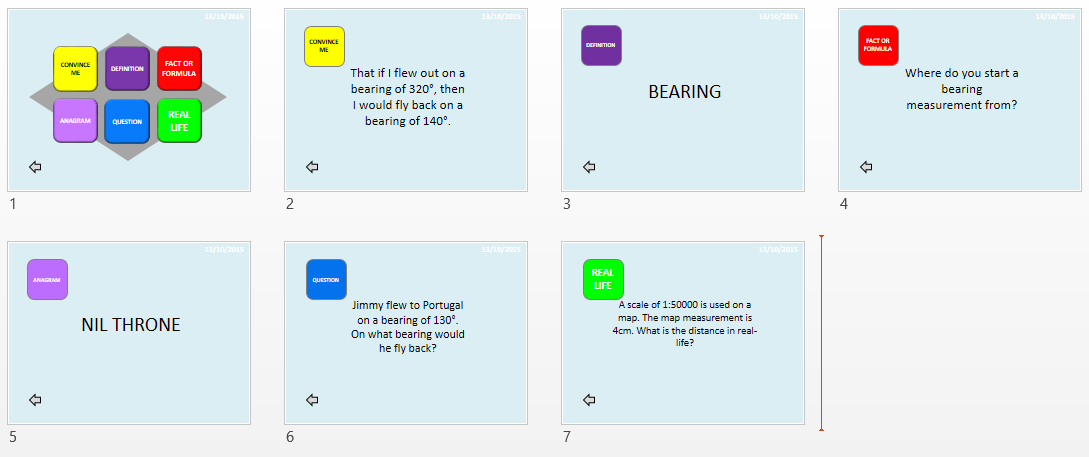
A quick plenary with 6 styles of question:

  • convince me
  • fact or formula
  • definition
  • anagram
  • question (procedural)
  • real-life (problem solving)


1st page (above) is hyperlinked so students can select which type of question they'd like to do (or all of them!)

Friday, 8 May 2015

#10minwin - To-Do List Categories

Following our first NQT conference, we had a session on time-management, which I am frankly terrible at. I get carried away with making resources sometimes at the detriment of more important tasks! We were advised not only to set time limits for certain tasks, but to rank priority into 4 main groups (seen below).


Outcome - I am now much more productive!

Wednesday, 6 May 2015

#10minwin - Burger Questions

I have a number of students for whom the final answer is the only thing of importance. Whilst there is no arguing with the fact that accuracy of the final result is key, I wanted to emphasise the justification and explanation of methods.

After reading a post on sandwich questions and with a penchant for burgers, have started to create worksheets in this format.


Result: with the answer already given, students have no option but to show how to get from question to answer. It also had the added bonus of highlighting misconceptions, as if the correct answer wasn't reached, then the method couldn't be correct. Plus, minimal marking required!

Sunday, 22 March 2015

#10minwin - Double-Sided Scaffolding

An idea which only popped into my brain whilst running through ideas with a music teacher... double-sided worksheets. Both sides have the same material covered, but one side has significantly more scaffolding.

This enables all pupils to be given the same sheet so no-one feels singled out, but pupils have a little more assistance if needed.

An example for an investigation of area and perimeter is below:
Non-scaffolded version - worksheets are given out this way up

Scaffolding for each section of the worksheet, specifically some examples to help pupils get started.

Friday, 6 March 2015

#10minwin - Planning to Teach Framework

Example of the Planning to Teach Framework for
the C2 chapter on Exponentials and Logarithms
During my PGCE we worked from and edited a Planning to Teach Framework, suitable for any topic.

Continuing to use this as a starting point during my NQT, I find myself adding to the misconceptions and anticipated after every lesson and test, thinking about ways to change the way I teach the topic the following year.

To save every beginning teacher from having to go through this process, I'm uploading the ones I have been working on so far in the hope that others can use them and add to them!

Planning to Teach Frameworks can be found here.

Thursday, 19 February 2015

#10minwin - Questions and Prompts - Thank You Anne Watson!

Away from the hustle, bustle, report and marking of the term, I find myself with some time to really think about how I am going to present the upcoming material to each year group.

Dusting off "Questions and Prompts" by Anne Watson and John Mason, under whom I was fortunate enough to train, I remembered all the wonderful ways to phrase questions that we'd looked at on my PGCE. Now to make sure they became a part of every lesson...

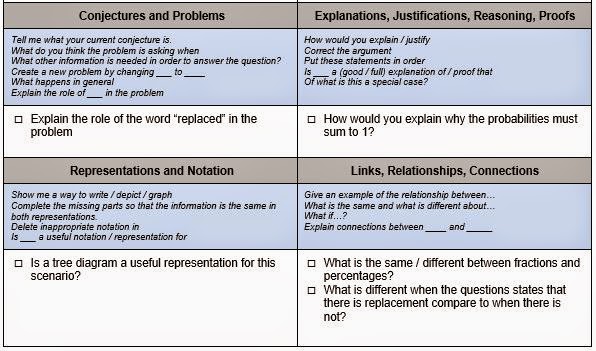
So as an additional to the PTTF (Planning to Teach Framework) I have created a Planning to Question Framework (PTQF) based on the ideas in this book. Following their categorisation, the framework is split into 8 sections:

  • definitions
  • examples and counter-examples
  • facts, theorems and properties
  • techniques
  • conjectures and problems
  • explanations, justifications, reasoning, proofs
  • representation and notation
  • links, relationships and connections

 On the right are a few ideas for probability, coming soon to a Year 7 class...

The original file can be downloaded and adapted from here.

Work in progress examples can be found in the PTQF folder here.

Thursday, 5 February 2015

#10minwin - PRET or LRMSS Homeworks

PRET homeworks enable students to Practise, Recall, Extend and Think on a given topic.

The skills section gives learners quick practise on the technique to ensure they are comfortable with it and this has the advantage of being easy to self-assess the following lesson.

Following a homework, the stretch question is done in class, with those that have been able to complete it giving input of their ideas and strategies for solving. I particularly liked Q2 here on linear equations!


Maths teachers everywhere seem to be jumping on this - with Jo @mathsjem compiling them all into this handy website!

Friday, 23 January 2015

#10minwin - Google Form Homework

The motivation of Lower 6th classes across the school is sometimes called into question by the number of students whose homework is not in on time, so I have begun to use online homeworks, giving me instant access to knowing who has completed the homework prior to going into the lesson.


Although it took a little bit of time to set up the questions and work the conditional formatting of the spreadsheet, I can now use this as a template for all online quizzes.

The actual homework can be found here: http://bit.ly/L6-C2-3

This also gave me the advantage of reinforcing the belief that teachers monitor pupil participation out of lessons and I was able to send brief emails to students the night before homework was due to ensure it was completed (see the difference between completion of the Class 2 students vs Class 1 due to this reminder!)

Thursday, 11 December 2014

#10minwin - Speed Mathing

Following an observation of Tony Ostersen's Religion & Philosophy lesson, I saw how effective sixth form pupils are at teaching each other and was eager to try it in mechanics.

Each pupil was given an exam question and given 15 minutes to solve it and prepare to teach it.

Students then arranged themselves on either the inner or outer circle (which I prepared whilst they were working individually on their questions) like so:


After each teach they looked less and less at their notes, as their fluency developed. I saw a wonderful side to a lot of the students, giving excellent demonstrations of knowledge and explanations.

Students used a variety of pre-drawn diagrams, question annotations & whiteboards in their teaching.
I was delighted that somebody re-dubbed Speed Dating as Speed Mathing!


They also filled in space in a grid for each "teacher" and what they had learnt on that table (they could write it down even if they already knew it too).

Here's the feedback:
:-) Pros
- fun
- saw different ways to approach problems
- more familiar with topics
- understand your question in great detail
- nice change

:-( Cons (and thoughts on how I can change for the better)
- time consuming
- could learn the wrong way
- would have liked more time to prepare

Changes to be Made
=> give students questions to prepare for homework so they can take as long as they like to work through and feel confident with it
=> consider having only 5 questions in circulation rather than 10. Each pair begins to work on the problem, then one of the pair has to move round with the question. By the end there should be 5 completed questions which everyone has some knowledge of.


Monday, 10 November 2014

#10minwin - Challenge 100

I love 100 squares.

You can look for all sorts of patterns, impose different rules for creating numbers, look for relationships amongst rows and columns...

So I stuck a massive one up on the wall.

Each month I've given pupils a different challenge, so far being:
(i) make any number using four 4s
(ii) make any number using five 5s
(iii) give an expression for any number based on where you see n

I should now explain the second point...
I love post-it notes.

Within one week of working at my NQT school, my head of department arrived in my room with 4 packs of post-its and 2 packs of mini post-its. Word travels fast.

To start with, I offered no incentive or reward for this challenge, yet pupils took it upon themselves to sporadically ask for post-its to complete a number that they'd worked out during the lesson.

A distraction? Possibly. But I can't see self-motivation to work on a number challenge as a bad thing.

Thursday, 30 October 2014

#10minwin - A Level Assessed Questions

Keeping my lower sixth pupils focused has been a challenge at time, so I introduced the expectation of an assessed question at the end of every lesson. Rather ad-hoc at first, I've now created them as worksheets which randomly select a question leading from the exercise that has been covered in the lesson...


Which can then be self-assessed before the bell, giving pupils instant feedback on whether they have achieved the learning objective for that lesson.


Spreadsheet of questions can be found here.


Friday, 17 October 2014

#10minwin - True or False Board

Probably one of the most heatedly discussed boards in my classroom: True or False?


Tackling misconceptions and insufficient explanations, pupils vote on whether they think the statement is true or false. At the end of the week the correct answer is revealed with an explanation.

My favourite moment had to be a gaggle of 1st years running to change their vote on the statement above, following a test on order of operations, as they realised they'd forgotten to divide before subtracting!

The statement bank can be found here - any more ideas greatly appreciated!