Pages

Showing posts with label Lesson Planning. Show all posts

Friday, 6 March 2015

#10minwin - Planning to Teach Framework

Example of the Planning to Teach Framework for
the C2 chapter on Exponentials and Logarithms
During my PGCE we worked from and edited a Planning to Teach Framework, suitable for any topic.

Continuing to use this as a starting point during my NQT, I find myself adding to the misconceptions and anticipated after every lesson and test, thinking about ways to change the way I teach the topic the following year.

To save every beginning teacher from having to go through this process, I'm uploading the ones I have been working on so far in the hope that others can use them and add to them!

Planning to Teach Frameworks can be found here.

Thursday, 30 January 2014

Nando's Takeaway Homework

After some more rooting around for ideas about homework, I found a blog with an example of a Take Away Homework as inspired by Teacher Toolkit's book. Having a little issue with the morals of KFC I decided to change mine to Nando's (marginally better), to be displayed in the classroom as well a takeaway menu for each student to take home.

Feedback on Receipts
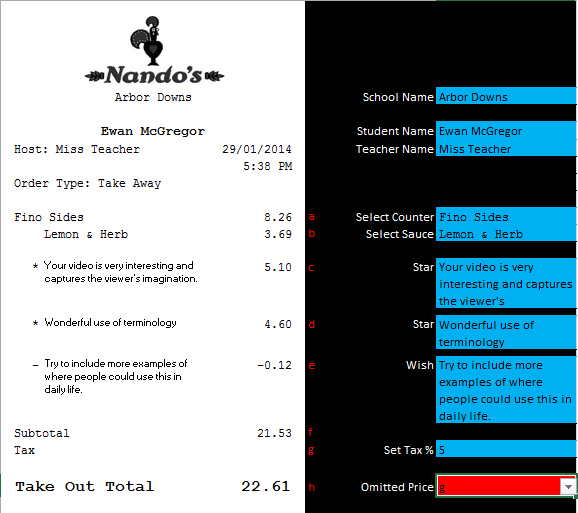
Using my love of spreadsheets I've created the menu on excel, and what better way to keep the theme than to give feedback in receipt form! If needing to give feedback one at a time (e.g. that wonderful moment when a student volunteers to do extra homework) then you can fill out the blue boxes and it will generate the receipt for you.

If on the other hand you have a whole class of homework to mark, there's a separate feedback form which will generate multiple receipts based on your inputs.

The advantage of providing the feedback on a receipt is that you can omit certain costs and as a second level they can calculate the missing cost. The missing costs are graded according to difficulty, allowing for differentiation (the highest level being missing tax, where the student has to calculate the tax and the percentage it was set at, allowing for rounding).
Spreadsheet generates receipts based on feedback input into above spreadsheet, You'd never guess I've been reading "Long Way Down" recently.

The spreadsheet can be downloaded here.

Saturday, 25 January 2014

Creative Homework

Inspired by @headguruteacher blog on the importance of homework, I set about creating a bank of creative ideas for maths homeworks. I've had great success in the past getting students to create mini-videos and writing postcards to relatives - they really take ownership of their work and I was incredibly impressed with the final product. It even ticks the literacy box too.
Extract from @headguruteacher blog.

@headguruteacher gave some great new ideas, which I've taken, adapted and added to, to make it suitable for a maths class.

As with all more open homework tasks, it is of paramount importance to discuss what would make a "good" standard and what would make an "excellent" standard, to ensure that pupils know what it expected of them.

For each homework, I intend to decide which of the tasks would be applicable, and present these to the class. Three students will be chosen at random to select which activity they would like to do, and the rest of the class can then select from these 3. I hope by using this strategy students will be able to take ownership of their work as before, but restrict the number of times they do the same type of task, as well as avoiding receiving 9 types of homework to judge equally.

I plan for many of these to be peer assessed, with those that chose a specific task to agree on a success criteria and mark 2 other pupils' work according to it.

Here are the ideas I'm working on so far, and a link to the spreadsheet that houses them - automatically creating a table to paste into a powerpoint from the teacher's selection, as well as sorting to see which activities have been less frequently used, to improve variety and analyse which tasks are preferred and why.
Snapshot of Creative Homework Spreadsheet
  • Record a 3 minute presentation for the class summarising what you learnt.
  • Visit the youtube video X. Write 200 words arguing whether you could / couldn't have learnt the topic solely through this video.
  • Draw a detailed pictoral representation of each of the keywords.
  • Take a picture or record a video of where you would use this in your life and comment on how you would solve it.
  • Describe your emotions as you progressed through today's lesson.
  • Produce a piece of artwork taking this topic as a stimulus and write a 200 character tweet to explain it.
  • Create a dictionary page for the keywords used in today's lesson.
  • Write an imagined discussion between a student who is struggling to understand ….. and a student who is helping them.
  • Design a brochure for the class to get them interested in what they will learn in the lesson.
  • Write a 400 character text message to a friend in class X, telling them all the knowledge they needed to have before they started today's lesson
  • Create an imaginary worksheet of questions based on today's topic, where the student makes a mistake on each one. Write the teacher's comments to help the student learn from their mistakes.
  • Draw a timeline to show the sequence of events that occurred in today's lesson.
  • Write a postcard to a relative explaining the concepts of…


Investigation on more or less successful activities to follow!

Wednesday, 5 June 2013

Making the Most of your NQT Year

Today's PDP session was run by 2 NQT's, who got us thinking about the things that would really improve our management skills as teachers. The session was run fantastically; here are some of the key pieces of advice that came out.


"The pre-RAG"


A cunning idea to cut down on marking time: get students to RAG their own work prior to handing it in.


GREEN: for something they are proud of

PINK: for something they want more help with.


This then means that you have something to praise, and something to work on immediately, and can give personalised feedback without it taking too long.


Additionally, using a routine colour scheme, for example purple for teacher feedback and green for pupils response will mean it is quick to check understanding in response to the questions that have been set.


Lesson Moulds & Templates
Have some pre-made powerpoint and lesson templates that encompass most of the different styles of lesson you will teach and share these with the pupils, for example:
"this is a jigsaw lesson" - and the pupils will know they will be slotting lots of mathematics together.

Other styles could be: exploratory, consolidation, practice etc.


Here's a video of the prompters we were using in the session:
Use the pause button to view prompters for longer.


Other Useful Pointers

  • don't try and fix everything when marking
  • plan term first, then the week
  • if you can do it in the next 5 minutes, do it in the next 5 minutes
  • make routines simple enough for students to explain to each other
  • use the same system for every class
  • "eat the frog"
  • keep a walk with me remembering device
  • reply to mass irrelevant emails with a "this isn't meant for me" style of email

Sunday, 12 May 2013

Snowballs

I've previously used snowballs as an icebreaker - given each student a piece of paper to write their name, something about themselves and the hardest maths question they can answer.

Recently it was suggested that it could be used to creating polished answers, by posing a question for each student on a card, then they throw them across the room and add to each others' answers. A possible (maybe ideal?) way it would be play out is shown below...


The ideas could then be shared with the class, as the person with the snowball would not be "responsible" for the ideas, merely sharing someone else's.

Saturday, 11 May 2013

Guess the Objective

With a bit of time of my hands this weekend, I've revisited an idea sent in the faculty newsletter, on a dingbat-style lesson objective.


Inspired by this, I've started to create a collection - can you guess which topics these are? Suggestions greatly appreciated!


Monday, 22 April 2013

The Lesson Planning Mountain

A strong focus of the department week has been on lesson planning.

Within our small groups, we analysed our own lesson plans to look for evidence of Learners' Mathematical Development, in terms of the following structure:
see - do - record

see - experience  - master

We were particularly sceptical of the latter of these structures, as experience didn't necessarily imply investigating, doing or analysing, before the pupil was expected to have reached the master phase.


The Lesson Planning Mountain
Instead, we began to consider the lessons using the analogy of a mountain climb of two peaks, as shown below.


  • The lesson begins with the class consolidating prior knowledge together, at base camp.
  • The climb begins with everyone walking together up the mountain, as new material is introduced. During this stage, pupils will begin to acclimatise to the higher altitude.
  • By the time the summit is reached, it is time for the pupils to part ways on their descent and continue as individuals.
  • Depending on how comfortable the students feel, they can sled, ski or abseil down (in increasing speed order). This gives the first opportunity for differentiation of activity.
  • At the point at which the second mountain comes into view, pupils can make the decision whether to climb higher to explore the subject in more detail or whether to continue practising as they head down the mountain.


Having previously seen the model of the tree where pupils label which person they think they are [insert link here], this mountain analogy could also be used, where pupils label where on the ascent they think they are at any stage in the lesson.

Tuesday, 5 March 2013

Big Picture Learning Objectives

Giving Pupils the BIG PICTURE  in the LOs:

Room Layout:
continue to change table arrangement to tables of 4 for Year 9 to encourage group work

Monday, 4 March 2013

That's a Genius Idea!

I've come to a stage where I've heard of and thought of lots of great ideas for teaching maths, but had no real way of sorting them, remembering them, or being able to search for them when re-teaching a topic.

So I've created a quick document which should give enough information to kick-start my memory and point me in the right direction to the resources on TES. The template is a work in progress... but essentially consists of:

  • main topic
  • sub-topic
  • key words (also helpful for when searching)
  • 4 real-life images relating to the topic (or something else if not yet thought of!)
  • main idea
  • links to TES resources


On the real-version (found here) all TES links are active. Hopefully a much better system than my brain!

Wednesday, 5 December 2012

Sick Day

So today was my first sick day - after lying on the floor after my last lesson yesterday I thought perhaps a day off might be required! Never one for complete rest, here are a collection of the notes from the PGCE scrapbook:

Useful Apps

No Hands
This allows you to type in the names of all your students in each class you teach, add what time you teach them, then can be used as an overlay in the corner of a PPT to randomly select names for questions - great when you're not sure of everyone's names!
If you have any trouble setting it up, Matt Kennedy is also a whizz :-)

Bomb Countdown
Scares the students to death but gets their attention back! It won't stop bombing of it's own accord so make sure you can easily get to the computer to turn it off!


Starting Off on the Right Foot
An extract from a newspaper article in PDP:
Don't start with the "rules lesson." Instead of lectureing them, do something that makes them go "Whoa!" Take a risk. Surprise them. Delight them.
This (sort of) fitted in with watching Sister Act 2 today (cringe!) She does this 3 lesson in, the one after they glue her bum to her chair :-S


Red, Amber, Green Trays
Following a lesson or assessment - ask students to place their books / papers into one of three trays depending on how well they think they understood the lesson.

Dish Up the DIRT
D = Dedictaed
 I  = Improvement (&)
R = Reflection
T = Time

Find time for students to work on their own or together to improve their work (provide a checklist for this to happen!)


Learning Objectives
Separate learning objective from context and include "success criteria" so that students know how they can achieve those objectives!


Just purchased labels so they can stick them into their books - one attempt at getting them to write it down turned out to be terrible!


Also, after a colourful display of language from a girl I had otherwise considered to be very well spoken, I'm going to try to give them cards if they say a swear word and get them to write down 5 alternative words they could have used - may go horrendously wrong but I thought it was worth a try!

Monday, 24 September 2012

Organisation Central

With so many things to think about, most of this evening was spent organising my tasks, room, food etc!

Here is a summary of the key points of today:

Preparing to Teach a Topic
Nick gave us a framework to use when planning to teach a topic, to help us think about all the different aspects which will guide us to plan tasks and lesson structure. Currently working on a database for this: Lesson Planning and Evaluation.


The essential questions are:

Motivation
1. Why is this topic worthy of study?
2. What is the relevance of this topic to life / maths?

Thinking
3. What images of experiences come to mind?
4. Have you ever thought about it differently?

Doing
5. What do you 'do' when you 'do' this topic?
6. What do you 'say' when you 'do' this topic?

We answered these questions for the topic of Negative Numbers. An important thing to consider with this topic is terminology, i.e. subtract, negative, minus etc.

Novel Mathematics
Nick gave out two sets of numbers and asked us to organise ourselves into groups of 3 or 4 where by adding or subtracting our numbers gave zero. 

TLC Meeting
We briefly got together as a TLC to decide on our observations for this week, the framework of which is in the Question Observation Template.


The afternoon was a PDP session on how race, gender, ethnicity, disability etc. affect your view of children as learners.