Pages

Showing posts with label Pedagogy. Show all posts

Thursday, 30 January 2014

Nando's Takeaway Homework

After some more rooting around for ideas about homework, I found a blog with an example of a Take Away Homework as inspired by Teacher Toolkit's book. Having a little issue with the morals of KFC I decided to change mine to Nando's (marginally better), to be displayed in the classroom as well a takeaway menu for each student to take home.

Feedback on Receipts
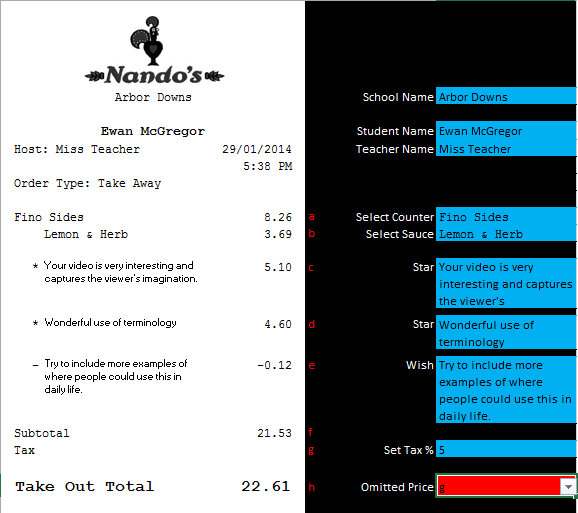
Using my love of spreadsheets I've created the menu on excel, and what better way to keep the theme than to give feedback in receipt form! If needing to give feedback one at a time (e.g. that wonderful moment when a student volunteers to do extra homework) then you can fill out the blue boxes and it will generate the receipt for you.

If on the other hand you have a whole class of homework to mark, there's a separate feedback form which will generate multiple receipts based on your inputs.

The advantage of providing the feedback on a receipt is that you can omit certain costs and as a second level they can calculate the missing cost. The missing costs are graded according to difficulty, allowing for differentiation (the highest level being missing tax, where the student has to calculate the tax and the percentage it was set at, allowing for rounding).
Spreadsheet generates receipts based on feedback input into above spreadsheet, You'd never guess I've been reading "Long Way Down" recently.

The spreadsheet can be downloaded here.

Wednesday, 5 June 2013

Making the Most of your NQT Year

Today's PDP session was run by 2 NQT's, who got us thinking about the things that would really improve our management skills as teachers. The session was run fantastically; here are some of the key pieces of advice that came out.


"The pre-RAG"


A cunning idea to cut down on marking time: get students to RAG their own work prior to handing it in.


GREEN: for something they are proud of

PINK: for something they want more help with.


This then means that you have something to praise, and something to work on immediately, and can give personalised feedback without it taking too long.


Additionally, using a routine colour scheme, for example purple for teacher feedback and green for pupils response will mean it is quick to check understanding in response to the questions that have been set.


Lesson Moulds & Templates
Have some pre-made powerpoint and lesson templates that encompass most of the different styles of lesson you will teach and share these with the pupils, for example:
"this is a jigsaw lesson" - and the pupils will know they will be slotting lots of mathematics together.

Other styles could be: exploratory, consolidation, practice etc.


Here's a video of the prompters we were using in the session:
Use the pause button to view prompters for longer.


Other Useful Pointers

  • don't try and fix everything when marking
  • plan term first, then the week
  • if you can do it in the next 5 minutes, do it in the next 5 minutes
  • make routines simple enough for students to explain to each other
  • use the same system for every class
  • "eat the frog"
  • keep a walk with me remembering device
  • reply to mass irrelevant emails with a "this isn't meant for me" style of email

Sunday, 12 May 2013

An Insight from Canada

During the Easter Department week, we were graced by John Mason, who shared a wealth of ideas and thoughts with us on attention - here are just some of the few I managed to jot down.

Our first task of the morning was this:
We all initially considered it individually, then discussed our thought processes as a group. One person started looking at the overview first before focusing down, another looked for a particular corner first before the rest of the shape, and another was mesmorised by a certain part of the diagram!

When we were given the answer, it was noted that a variety of emotions: delighted / satisfied / depressed / cheated were felt, depending upon how far through the problem a person had worked.

Parking
One of the key ideas of the session was to develop pupils' ability to park an idea; when they had a good idea, temporarily put it to one side and see if there is a more efficient way of doing it, rather than just ploughing on through.

Just
Having said I'd aim not to use this word, I realise I've written it in the sentence above. "Just" implies a simple step, in the eyes of the speaker, but it may not be so in the eye of the listener, so should be avoided.
If a student is attending to a problem in a different way, they may not be able to hear what you're saying, unless you give sufficient detail to show how you are attending to it prior to any further development.

Group Discussion
Throughout this session, John elicited ideas from us and exemplified classroom techniques. The two I have taken away from this are:

Please
In PDP sessions in my S1 school, we were advised to use thank you rather than please as a behavioural technique. However, although this is effective in terms of showing pupils that a behavioural pattern is expected, I had almost forgotten where please could be used to equal effect/
As John called upon us to offer our opinion, he said please, inviting us to talk and demonstrating that he was interested in our comments.

I think I want to modify my conjecture
A helpful alternative to "bummer, that doesn't make any sense"

Say What You See (SWUC)
Possibly stolen from catchphrase this was really helpful in allowing pupils of all abilities to participate, such that everyone can succeed - it lowers the threshold. This was implemented with the image below.


Update 22/05/2013: Used this with a Year 9 class who weren't particularly vocal but came out with some good ideas, particularly when we allowed the large blue block to be worth £300 and determined how much each of the other blocks would be worth.
However, one comment: "I notice it's a fraction wall cos I did it in Year 8" was followed by further discussion, where the student in question knew it was a fraction wall but couldn't tell me any fraction that the wall could represent. Perhaps not so memorable, or not enough discussion in Year 8?

A Selection of Activities
Without time to comment on further, here are some of the other ideas that appeared in the session...


Tuesday, 7 May 2013

Working with Groups

Yesterday we took part on a fantastic session on working in groups (note: categorically NOT group work.) The emphasis of this session was on using the activities in a pastoral setting, but many could be equally applied to a curriculum lesson.

Fruit Salad
This initially activity was an icebreaker, where each person stated their name, their hero and a reason for their choice. The catch was, as we went around the circle, each person had to say the names and heroes / heroines of those that had previously introduced themselves. (N.B. The reasons for the choices do not have to be remembered) By the leader of the group positioning themselves at the end, this gives a good amount of time to learn names.
A further development for this is to have one person standing in the middle stating 2 heroes / heroines, who then have to move to another seat. The goal of the person in the middle is to get to the free seat before the movers can. If the person in the middle prefers, they can call "heroes" and everyone has to change seat.

Mathematical Adaptation
Substituting favourite number for heroes and heroines would also be a good icebreaker, as students often have interesting stories for their preferred numbers. In the latter part of the activity, mathematical sums could be given to arrive at possible favourite numbers, ranging from clues such 7+1 to sin(pi/2).


Chair Numbers
In this activity, each chair in the circle was assigned a number. Adapted from the zoomy-zoomy drinking game, each player states their chair number, then another number, e.g 4 - 1. The catch here is that you cannot send it back to the chair you had before.
This activity can be developed to use different labels for the chairs, for example emotions then if the group is ready for it, they can then discuss which chair they think they should be on today and which chair they would least like to be on.
The final version was very effective in getting the members to be more comfortable with certain vocabulary, in the context of sex education.

Mathematical Adaptation
Each chair could be named by a mathematical keyword.


Teddy's 5
A chance for people to show their knowledge on a particular topic, those around the outside challenge the person in the middle to list 5 of a category, for example 5 football teams in the premiership. The person in the middle then has to list these before the teddy bear gets back around to the challenger.
Mathematical Adaptation
5 things associated with right-angled triangles. To ensure good topics were being selected, it might be useful to start with a card to be given to each person, from which they can select a topic. This would give a better idea of the style, then the group could move onto choosing their own.

I imagine...
Here the aim is to get out any preconceptions about a personand give the person in the spotlight the opportunity to coounter these, where in other situations they might not have had the opportunity.
When introducing this exercise it is important to give a mixture of superficial and meaningful examples, e.g.
- I imagine that you prefer cornflakes to rice krispies
- I imagine that you get on better with your Mum than your Dad
It must be stressed that you cannot say anything that you know to be true, only things that you imagine about a person.

Differences
Here, the person in the hotseat can only get out of it if they say somehting about themselves that isn't true of anyone else. If it is true of someone else, they must say so, and the person remains in the hotseat.

Positives
One person becomes the guesser, and faces  outside the circle. By silent pointing, the group decides who is going to be described. Each person in the circle then has to describe the person with a postive thing, e.g. "This person has really nice blue eyes." Afterwards, the guesser can turn around before making a guess.
It is very important that no-one is able to pass, as this sets a precident. Instead, go back to that person at the end,  to avoid slowling the pace.

Thursday, 7 February 2013

Too Exciting Problems!

Classroom Management
This morning began with a continuation of the classroom management discussion from yesterday.

  • Benchmarking: draw a line in pupils books to help them see how much work they've done in 5 minutes  - possible photocopy and send home?
  • Quiet Word: avoids giving pupils the attention they may be craving with their behaviour
  • Orders not Requests: removing the "can do" option makes it non-negotiable; adding "thank you" at the end compels them to follow instructions
Seating Plans
  • seating plans for instruction, then can work with whoever they want providing they remain on task; bring back to seating plan if not
  • study buddies: get students to decide who they work well with
  • seat pupils with a friend but not in friendship groups
How Important is Proof?
Proof was the main part of our discussion today. Initially we all had varying definition of proof, so described it as:
Proof: a valid argument that logically builds on knowledge that the students already have to get to the next step.
 We then looked at a progression of problems given in a lesson aimed at motivating proof..


Motivation
The above is an example of motivation for the study of proof, in the same way that the algebraic magic triangle is motivation for the study of algebra.

Individual task motivation could also be achieved by having codes, padlocks and prizes.

The full article written by Andreas Stylianides can be found here.


Polynomial Division
On a total sidenote to the whole session, I learnt synthetic division today (RH working):
As it's very removed from what you're actually doing with polynomial division, I'd be reluctant to teach it this way, but use it myself to check pupils' answers quickly and/or teach to Year 13s if I feel they have a full understanding of the concept and therefore would just be giving them an alternative method.

Proof of Adding +ve and -ve


Tuesday, 5 February 2013

Blonde Hair ... tis a problem.

Language
The session began as a follow on to yesterday's EAL focus; discussing language in mathematics.

Common confusion with words came up:

  • minus & negative
  • trials & events
  • alternative and alternate angles
  • random & strage
  • area & perimeter
In order to combat this, a possible idea is to use games such as Taboo (or Oobat, as pupils are encouraged rather than not allowed to use the words on the cards) and Articulate (or Mathiculate, link here.)

Definitions
So it turns out that none of us can define anything - on being asked to draw a diagram, we nearly all drew something with 4 sides and a rectangle - a very particular case! Instead, a much more open example such as:
We were encouraged to focus on the meaning of words rather than their definitions; especially in considering the context in which the word was used.

One possible ideas was to split the class in half, having them each working on different things, e.g.
  • multipling and adding fractions
  • adding and multipling negative numbers
  • intercept and gradient
  • a squared and 2a

A Level Teaching
Nick's session on A level teaching followed, with a match-up activity of graphs, their derivatives and stationary points.
We then created our own activity for a topic we may be teaching.

Our activity was on momentum and is most definitely a work in progress...
The first steps involve matching the worded problem with initial and final diagrams:


then sorting these sets into one of the boxes in the table below:

Conservation of energy and momentum are both considerations here!

Problem Solving
Gabriel's session began with a blonde problem (I really did feel blonde after failing to answer it!)

A discussion followed on the importance of giving us time to first read and think about the question, before group discussion was allowed. We were also given a task to step out of problem solving to write down what we felt about the task, and again at the end - a great way to consider emotions with problem solving.

Friday, 25 January 2013

I have a dream...

Last week one of the pupils in my tutor group ran a 'Dreams and Aspirations' session.

Staff joined in too:

We then asked the class what we could do to help us reach our dream. One of the ideas was for the pupils to select their own learning buddies.

So I gave it a go! They filled in who they wanted to be their study buddy on a live form.

and thought hard about who they would learn well with - some surprising choices came out! I've had one lesson in the new arrangement so far and it's gone well - fingers crossed it continues!

Wednesday, 5 December 2012

Sick Day

So today was my first sick day - after lying on the floor after my last lesson yesterday I thought perhaps a day off might be required! Never one for complete rest, here are a collection of the notes from the PGCE scrapbook:

Useful Apps

No Hands
This allows you to type in the names of all your students in each class you teach, add what time you teach them, then can be used as an overlay in the corner of a PPT to randomly select names for questions - great when you're not sure of everyone's names!
If you have any trouble setting it up, Matt Kennedy is also a whizz :-)

Bomb Countdown
Scares the students to death but gets their attention back! It won't stop bombing of it's own accord so make sure you can easily get to the computer to turn it off!


Starting Off on the Right Foot
An extract from a newspaper article in PDP:
Don't start with the "rules lesson." Instead of lectureing them, do something that makes them go "Whoa!" Take a risk. Surprise them. Delight them.
This (sort of) fitted in with watching Sister Act 2 today (cringe!) She does this 3 lesson in, the one after they glue her bum to her chair :-S


Red, Amber, Green Trays
Following a lesson or assessment - ask students to place their books / papers into one of three trays depending on how well they think they understood the lesson.

Dish Up the DIRT
D = Dedictaed
 I  = Improvement (&)
R = Reflection
T = Time

Find time for students to work on their own or together to improve their work (provide a checklist for this to happen!)


Learning Objectives
Separate learning objective from context and include "success criteria" so that students know how they can achieve those objectives!


Just purchased labels so they can stick them into their books - one attempt at getting them to write it down turned out to be terrible!


Also, after a colourful display of language from a girl I had otherwise considered to be very well spoken, I'm going to try to give them cards if they say a swear word and get them to write down 5 alternative words they could have used - may go horrendously wrong but I thought it was worth a try!

Tuesday, 20 November 2012

WWW & EBI from Pupils

I asked my Class Teacher to run a brief activity with my class when I wasn't there to ask for WWW and EBIs about my teaching. Some were really uplifting and some were things I hadn't realised I was / wasn't doing so definitely some useful points to work on. Full notes on this are here, but below I have written some of my most pressing thoughts.


So it seems that in general they like the variety of activities, particularly when they are doing group work (including when they are teaching their peers) and the silent lesson went down a treat.

Questioning
A big concern is choosing which students to ask questions to, and something I remember feeling frustrated about at school.
I want to ask the students who have their hands up, as they are so excited that they know the answer, but obviously then you’ll probably only hear from ¼ of the class throughout the entire lesson. Instead, I was advised to use the ‘hands down’ policy, which has served to get many of the pupils interested in the task, but I then received this feedback from a pupil “I don’t like it when you pick on people when they don’t know but other people are desperate to answer,” which goes back to the original problem of frustration, so I am again questioning the technique.
A possible solution to this lies in the use of whiteboards, getting students who think they know the answer to write things down on whiteboards and hold them up so that I am aware that they know it, but in the meantime use the random name generator to select a student to answer the question initially. I think this would work best if I first asked the students why they think it is important that I find out that some people don’t know the answer.

Task Explanation
A further concern is in how I am explaining my tasks – one student commented that I am “good at explaining what we need to do” yet another said “make the task more clear so people understand better.” Unfortunately I think part of the confusion may lie in the fact that they are not always concentrating when the task is being explained, but I am also aware that many of my explanations have been rushed, especially when I am excited for them to get onto the task!
Perhaps a bit more time spent on explaining with bullet points on the board, and leaving them up, might help. Alternatively, more detailed task explanations could be given to some students if they are continually struggling, but this would involve publicly identifying them, which I would like to avoid.

Relationships
My final, and most upsetting, concern, was a student who said “you talk to other people on my table more than me.” Due to a poor scribbling out on the paper, I have been able to identify the table on which this student sits and will make a concerted effort to speak to all of them equally until the relationship has been mended. However, the student who they felt I spoke more to, was the student on the table who needed more attention in general as he is one of the weaker students in the class. Arrrgh!

Monday, 29 October 2012

Rich Tea or a Hobnob?

Our first useful PDP session - a truly fantastic lecture.

I think we were all relieved to hear that the guy who was lecturing us was "crap" when he first started out, but has clearly improved an awful lot since - he had our undivided attention for the entire session!

It was suggested that we had "just enough control for you to be able to teach," rather than aiming for a palpable air of fear when we walk into the room.

We were directed to read Charlie Taylor's Behaviour Checklist (notes here), use gold stars with all age groups and learn names as quickly as possible.

And finally, it was time for Peter Kay...

Thursday, 20 September 2012

Multiplying Multi-Digit Numbers by 7


Title
: Multiplying Multi-Digit Numbers by 7
Learning Objective: Multiplying Multi-Digit Numbers by 7
So what do you think the lesson is about today? Multiplying Multi-Digit Numbers by 7
So today began with the lesson from hell, Anne maxed us all out by putting us in an actual lesson situation, which we were then to tear apart after she'd finished! We came up with a whole load of ways in which it was "wrong" - how long until I accidentally make one of those mistakes :-S The main issues were:

  • insufficient number of examples
  • no examples written down or left on board
  • blamed a mistake she made on us
  • didn't qualify what "show working" meant
  • didn't allow us to use the method we were used to
  • no space on worksheet
  • completely unenjoyable!
I also found out something very interesting about dyslexia, that students struggle to read and write at the same time - something to consider. Another intern was particularly helpful in highlighting some other points to think about to make it easier.

We were then introduced to our first task:
Task 1: Writing on a Whiteboard
More notes on this task can be found on the Maths Tasks document.

A random idea that came to me was for a possible plenary activity: "This maths will be useful to me in the future because..." perhaps to encourage students that the topic will actually be useful!

We were then looking at ways to be articulate in mathematics; our words are below.


Sticker Match up Lesson with Nick
The class began with each student being given a sticker with a shape on it and sent outside - we were to get into groups of similar shapes, then split into two according to a criteria we decided upon.
Back in the classroom we were given a sheet of all the shapes in our group and asked to think of different ways to group them.

N.B. These were on stickers which we stuck onto post its so they were "easier to move around."
A possible extension to this, would have been to have each shape labelled with a prime number, then multiply those in each group together, give it to the other "half" of our group and get them to do prime factor decomposition to work out the groups. They would then need to look at the pattern to find out which group one belonged to.

Two types of knowledge:
Subject knowledge
Pedagogical subject knowledge  (articulating the ideas to a class)

Novel Mathematics
Kaprika's Problem
 
Any three digit number, providing it had at least two different digits that were more than one apart would follow this pattern.
a) Arrange digits into largest possible number
b) Arrange digits into smallest possible number
c) Subtract from each other
d) Take answer and repeat
It would always converge to 9.
 
Extension: Think about convergence in different bases. Doing this in base 8 made us consider what it might be like for struggling student to do it in decimal!
Another thing to consider is what do you do when some of the class get it and some don't?
  • extend for those that understand, repeat to improve others
  • bring whole class together
The day finished with our Friday Reflections Assignment, a retrospective look back at this week for Monday and deciding on our topic for next week. This is within our TLC, topic discussion can be found in the Friday Reflections W/B 24/09/2012 document.


Tuesday, 18 September 2012

First Day of Maths

So after all the overwhelming amount of information we've been given and the number of things I need to keep track of, I can't think of any other way to do this except keep a blog!
So here it is, my diary of this apparently hellish year, all compacted into one place. Horrah!

The day begin with an effective icebreaker, which had some other underlying aims, a theme we were to see repeated throughout the day. The first idea I particularly liked, so will code this under my "novel mathematics" colouring:
Novel Mathematics
Each student was given a post-it to put on their head. We were then to ask questions to other students to allow us to guess our post-it, e.g. am I a prime number, am I a function etc.
A phrase to remember was:
Work out what delayed you today, so you can ensure you arrive on time tomorrow.
When students arrived late, the teacher asked others on their table to bring them up to speed. We are advised to consider management of resources to ensure they were used most effectively.
When asking questions, it became important to ask students who would have something to say, e.g. after group work. Avoid shaming pupils who aren't paying attention but instead use a phrase such as:
Matthew you've gone off somewhere, can you come back to us please.
Shown that movement of pupils is not necessarily a bad thing but can be used to carry ideas around the room; avoid it seeming like a punishment.

The session culminated in discussing our observations from the previous week in our TLC group, notes of which can be found here:
20120918 Contrasting Techniques for Behaviour Management between Primary and Secondary Schools

The plenary was an exercise in class counting down in fractional increments - harder than it sounded!