This idea came from OCR
Get three volunteers from the class. They will sit at the front relatively far apart from
each other. One of them will be blindfolded and will be ‘See no evil’, the other will have
headphones on listening to music (at a reasonable volume but not enough to damage their
hearing!) and be ‘Hear no evil’ and the other will not be allowed to speak and be ‘Speak no evil’.
You each give them one piece of information from one square on Activity Sheet 4. You also inform
‘Speak no evil’ of what variable they need to find out. You give them a time limit of 5 minutes to
communicate with each other all the pieces of information and they have to have a correct answer.
This is a fun, end of topic activity that can be very entertaining to watch. The key is to use the
whiteboards. The student who cannot see can speak and hear and similarly for the other students
and their other senses. Students have to figure out a strategy to communicate their ideas to each
other effectively. Remember they can write messages on their whiteboards which is crucial for the
student who cannot hear or speak! You may want to do an example first. Students not involved
should have access to the information you have given them and be encouraged to calculate the
answer themselves. In fact you could make the rest of the class the judge of whether the particular
group has succeeded in their task.
Thoughts
- students have to work as a team
- all students in team have to be involved for it to work
- what are other students in the class doing?
- does this have more impact than practising questions normally in groups?
Possible Adaptations
Although this might take a little while to explain the first time, it could be used again with other topics in small groups, where each of the roles (including teacher giving information) is taken by a set of 4 students, so all students are involved.
Showing posts with label Mechanics. Show all posts
Showing posts with label Mechanics. Show all posts
Tuesday, 28 June 2016
Thursday, 30 October 2014
#10minwin - A Level Assessed Questions
Keeping my lower sixth pupils focused has been a challenge at time, so I introduced the expectation of an assessed question at the end of every lesson. Rather ad-hoc at first, I've now created them as worksheets which randomly select a question leading from the exercise that has been covered in the lesson...

Which can then be self-assessed before the bell, giving pupils instant feedback on whether they have achieved the learning objective for that lesson.

Spreadsheet of questions can be found here.

Tuesday, 5 February 2013
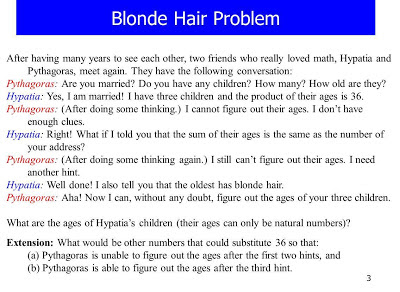
Blonde Hair ... tis a problem.
Language
The session began as a follow on to yesterday's EAL focus; discussing language in mathematics.
Common confusion with words came up:


The session began as a follow on to yesterday's EAL focus; discussing language in mathematics.
Common confusion with words came up:
- minus & negative
- trials & events
- alternative and alternate angles
- random & strage
- area & perimeter
In order to combat this, a possible idea is to use games such as Taboo (or Oobat, as pupils are encouraged rather than not allowed to use the words on the cards) and Articulate (or Mathiculate, link here.)
Definitions
So it turns out that none of us can define anything - on being asked to draw a diagram, we nearly all drew something with 4 sides and a rectangle - a very particular case! Instead, a much more open example such as:

We were encouraged to focus on the meaning of words rather than their definitions; especially in considering the context in which the word was used.
One possible ideas was to split the class in half, having them each working on different things, e.g.
- multipling and adding fractions
- adding and multipling negative numbers
- intercept and gradient
- a squared and 2a
A Level Teaching
Nick's session on A level teaching followed, with a match-up activity of graphs, their derivatives and stationary points.
We then created our own activity for a topic we may be teaching.
Our activity was on momentum and is most definitely a work in progress...
The first steps involve matching the worded problem with initial and final diagrams:

then sorting these sets into one of the boxes in the table below:

Conservation of energy and momentum are both considerations here!
Problem Solving
Gabriel's session began with a blonde problem (I really did feel blonde after failing to answer it!)

A discussion followed on the importance of giving us time to first read and think about the question, before group discussion was allowed. We were also given a task to step out of problem solving to write down what we felt about the task, and again at the end - a great way to consider emotions with problem solving.
Subscribe to:
Posts (Atom)