Pages

Showing posts with label Algebra. Show all posts

Friday, 1 July 2016

#10minwin Deepening Thinking Template

Following the OTP I've been looking for ways to really deepen thinking of all students, particularly with tasks that are self-differentiating.

I loved this idea from @MissDks2 ...

... so have been developing it for use with Year 7 Mastery SoL next year.

We're particularly looking at developing their questioning skills, hence the slight change to the template above

Here's the first draft, with an example of solving equations.

Template can be found here.

Saturday, 11 May 2013

Guess the Objective

With a bit of time of my hands this weekend, I've revisited an idea sent in the faculty newsletter, on a dingbat-style lesson objective.


Inspired by this, I've started to create a collection - can you guess which topics these are? Suggestions greatly appreciated!


Wednesday, 24 April 2013

Sequence Zoo

In preparing for a Year 8 revision lesson for a SATS paper, I came across the following questions:


This is a great example of the requirement for proof and reasoning: any of the nth term expressions would fit the first three terms of 1, 2 and 4, yet depending on the situation it is likely that some of the expressions would be inappropriate.


It is also reminded me of an idea of Lucia Handley, using cubes to investigate sequences.


The Sequence Zoo

The lesson began with an arrangement of animals: giraffes, pigs and cows/zebras. Pupils could then be challenged to work out what the baby of each animal looked like, or to work out whether they could give the number of bricks required to make a species, given its height.

Alternatively, the animals in the image above could be used and pupils had to find out which animal had grown out of sequence.

The cow/zebra is particularly interesting, as you could look either at total number of blocks, or the white / black components.

Thanks Lucia!

Tuesday, 23 April 2013

Maths is Just Another Language

Inspired by the video of the 10 year old maths teacher, I want to increase my focus on maths as a language.

For example,

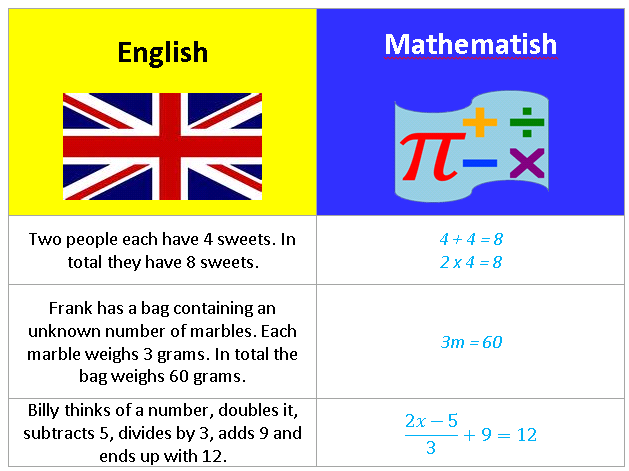
Translate these sentences into mathematish


These could be adapted to suit each topic but overall should help students to understand how expressions are formed and therefore also to interpret them. This falls in line with Anne Watson's thinking that students should be taught to read algebraic sentences out loud to give them meaning.

UPDATE: 28/05/2013
For algebra specific translations, translating english to algebrese

When you take a real-world situation and translate it into math, you are actually 'expressing' it; hence the mathematical term 'expression'.

Saturday, 5 January 2013

Algebra Tiles

In Anne's Algebra sessions we were introduced to Algebra Tiles.
Using algebra tiles to express (a+b)(a+b)


The templates for these can be found here. Acadia list a number of ways that they can be used, which can be accessed here. A few applications are found below:

COLLECTING LIKE TERMS


EXPANDING BRACKETS

X2R3
R2R23R
24R6


UPDATE: 22/05/2013
Having used these with a Year 9 class where the general teaching style is less exploratory and more methodical, I received the following feedback (food for thought!)
  • confusing because they weren't labelled
  • didn't need them
  • gave me one more thing to remember
  • distracting for some students
  • helped me a little but confused me compared to the way I already knew it
  • they helped me solve equations
  • I could literally see the equation and understood it better
  • gave me a visual way of doing the sum
  • interactive and helpful to get started with the grid method
  • easier to understand the method we were using

Friday, 4 January 2013

New Year Algebra

We were advised to look at Anne's paper on Algebraic Reasoning.

The key ideas of algebra were decided to be:

  • relationships
  • representation
  • generalising
  • communication
  • mathematical objects
"If you always do what you always did, then you'll always get what you always did"
In defining a variable (for Barry!):
2y + 1
Get students to put in values for y and see what happens when something is a variable.

Begin algebra by using it to express things they already know, and use "non-calculation arithmetic", e.g.
2 + 8 = 8 + 2
therefore ....
a + b = b + a

A dance routine was used to see how like terms could be found, or more importantly, what like terms actually were!
[dance routine]


We were advised to be careful with tables when asking students to create them in order to find a formula - rather checking that the formula that they had fitted the structure of the problem.

e.g.  matchsticks
The formula:
3n + 1
Only makes sense because you are adding 3 matchsticks on each time, however a quadratic or sinusoidal curve could equally fit the results if only these situations are considered.

The activity involving ordering algebraic expressions with each person choosing an appropriate value for x was also very interesting.

Dan Meyer has some interesting ideas about algebra in mathematics:

We were also advised to read