Pages

Showing posts with label Language. Show all posts

Saturday, 25 January 2014

Creative Homework

Inspired by @headguruteacher blog on the importance of homework, I set about creating a bank of creative ideas for maths homeworks. I've had great success in the past getting students to create mini-videos and writing postcards to relatives - they really take ownership of their work and I was incredibly impressed with the final product. It even ticks the literacy box too.
Extract from @headguruteacher blog.

@headguruteacher gave some great new ideas, which I've taken, adapted and added to, to make it suitable for a maths class.

As with all more open homework tasks, it is of paramount importance to discuss what would make a "good" standard and what would make an "excellent" standard, to ensure that pupils know what it expected of them.

For each homework, I intend to decide which of the tasks would be applicable, and present these to the class. Three students will be chosen at random to select which activity they would like to do, and the rest of the class can then select from these 3. I hope by using this strategy students will be able to take ownership of their work as before, but restrict the number of times they do the same type of task, as well as avoiding receiving 9 types of homework to judge equally.

I plan for many of these to be peer assessed, with those that chose a specific task to agree on a success criteria and mark 2 other pupils' work according to it.

Here are the ideas I'm working on so far, and a link to the spreadsheet that houses them - automatically creating a table to paste into a powerpoint from the teacher's selection, as well as sorting to see which activities have been less frequently used, to improve variety and analyse which tasks are preferred and why.
Snapshot of Creative Homework Spreadsheet
  • Record a 3 minute presentation for the class summarising what you learnt.
  • Visit the youtube video X. Write 200 words arguing whether you could / couldn't have learnt the topic solely through this video.
  • Draw a detailed pictoral representation of each of the keywords.
  • Take a picture or record a video of where you would use this in your life and comment on how you would solve it.
  • Describe your emotions as you progressed through today's lesson.
  • Produce a piece of artwork taking this topic as a stimulus and write a 200 character tweet to explain it.
  • Create a dictionary page for the keywords used in today's lesson.
  • Write an imagined discussion between a student who is struggling to understand ….. and a student who is helping them.
  • Design a brochure for the class to get them interested in what they will learn in the lesson.
  • Write a 400 character text message to a friend in class X, telling them all the knowledge they needed to have before they started today's lesson
  • Create an imaginary worksheet of questions based on today's topic, where the student makes a mistake on each one. Write the teacher's comments to help the student learn from their mistakes.
  • Draw a timeline to show the sequence of events that occurred in today's lesson.
  • Write a postcard to a relative explaining the concepts of…


Investigation on more or less successful activities to follow!

Tuesday, 23 April 2013

Maths is Just Another Language

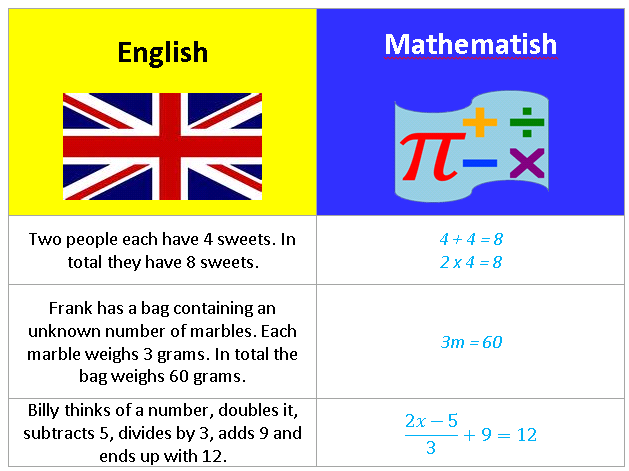
Inspired by the video of the 10 year old maths teacher, I want to increase my focus on maths as a language.

For example,

Translate these sentences into mathematish


These could be adapted to suit each topic but overall should help students to understand how expressions are formed and therefore also to interpret them. This falls in line with Anne Watson's thinking that students should be taught to read algebraic sentences out loud to give them meaning.

UPDATE: 28/05/2013
For algebra specific translations, translating english to algebrese

When you take a real-world situation and translate it into math, you are actually 'expressing' it; hence the mathematical term 'expression'.

Tuesday, 19 February 2013

Delphi Method

Wikipedia

The Delphi method (pron.: /ˈdɛlfaɪ/ del-fy) is a structured communication technique, originally developed as a systematic, interactive forecasting method which relies on a panel of experts.[1]
In the standard version, the experts answer questionnaires in two or more rounds. After each round, a facilitator provides an anonymous summary of the experts’ forecasts from the previous round as well as the reasons they provided for their judgments. Thus, experts are encouraged to revise their earlier answers in light of the replies of other members of their panel. It is believed that during this process the range of the answers will decrease and the group will converge towards the "correct" answer. Finally, the process is stopped after a pre-defined stop criterion (e.g. number of rounds, achievement of consensus, stability of results) and the mean or median scores of the final rounds determine the results.[2]

As I am about to move onto area and perimeter, words with which many pupils seem to struggle, I thought it might be an idea to use this Delphi method as a way to elicit meaning from the pupils, highlighting misconceptions then attempting to narrow down to a definition that all pupils agree with and can understand.

Possible Implementation: in silence each student writes down their own definition, then discuss to find best definition in groups of 4 - read out to class inc. any that they discarded because they thought it wasn't correct.

Thursday, 7 February 2013

Mathematical Language Idea

A fab find on Mr. Collins' blog - Mathematical Concepts Wall! This idea ties in nicely with the week's focus on mathematical language.


For more info, see his blog post here.

Tuesday, 5 February 2013

Blonde Hair ... tis a problem.

Language
The session began as a follow on to yesterday's EAL focus; discussing language in mathematics.

Common confusion with words came up:

  • minus & negative
  • trials & events
  • alternative and alternate angles
  • random & strage
  • area & perimeter
In order to combat this, a possible idea is to use games such as Taboo (or Oobat, as pupils are encouraged rather than not allowed to use the words on the cards) and Articulate (or Mathiculate, link here.)

Definitions
So it turns out that none of us can define anything - on being asked to draw a diagram, we nearly all drew something with 4 sides and a rectangle - a very particular case! Instead, a much more open example such as:
We were encouraged to focus on the meaning of words rather than their definitions; especially in considering the context in which the word was used.

One possible ideas was to split the class in half, having them each working on different things, e.g.
  • multipling and adding fractions
  • adding and multipling negative numbers
  • intercept and gradient
  • a squared and 2a

A Level Teaching
Nick's session on A level teaching followed, with a match-up activity of graphs, their derivatives and stationary points.
We then created our own activity for a topic we may be teaching.

Our activity was on momentum and is most definitely a work in progress...
The first steps involve matching the worded problem with initial and final diagrams:


then sorting these sets into one of the boxes in the table below:

Conservation of energy and momentum are both considerations here!

Problem Solving
Gabriel's session began with a blonde problem (I really did feel blonde after failing to answer it!)

A discussion followed on the importance of giving us time to first read and think about the question, before group discussion was allowed. We were also given a task to step out of problem solving to write down what we felt about the task, and again at the end - a great way to consider emotions with problem solving.

Monday, 4 February 2013

Bimbles, Gloops and Flobs

Today's OUDE session was spent at Oxford Spires Academy, which has a high EAL population and hence was our focus for the day. The day consisted of a mixture of observations, EAL discussions sessions and a debrief with Anne.

Nonsense Questions
By far one of the most useful parts of the day for me was the idea of nonsense questions. In simplest form, all non-essential mathematical language is replaced with random words, such as:


A question like this puts native speakers and EAL students on a level playing field, where no-one knows what bimbles, gloops or flobs are, but should be able to do the mathematical calculations required to answer the question.

A further extension to this might be to give them the original question and then highlight the words that were unimportant to the understanding of the question.


Fractions
We were advised to use the Oxford Primary Maths Dictionary for EAL students, as it has useful pictures and descriptions of mathematical key words, e.g.

Fractions: the bottom part (denominator) tells you the number of equal parts. The top part (numerator) tells you the number of those part you are dealing with.

However, this definition made no logical sense when considering 8 over 5 for example, or when doing algebraic fractions. Instead, the division definition might be more appropriate:


On a slight slide note, one of the teachers at the school found a memorable way to introduce top heavy fractions, with a little help from Katie Price...
Jordan Fractions: memorable top heavy fractions

Interesting Teaching...
Although not directly related to EAL, I saw a few examples of interesting teaching today as well.

Speed, Distance Time Graphs
Rather than asking the pupils to answer a list of question on SDT graphs, the teacher instead presented them with graphs and asked the pupils to tell their story.
I give the following as a pupil example:
"I was on my way to Nottingham to see my friend Georgia. It took me 3 hours to get there and my speed was 60mph. I then arrived and spent 1 hour having a poo. Then I took Georgia's dog for a walk at a speed of 5mph. My average speed for the whole day was 38mph."
Units and Measure
In preparation for lessons on unit and measure, pupils were asked to answer the following questions:

  • How much coca-cola is in a can?
  • How far is it from Oxford to London?
  • How tall are you?
  • How long is your fingernail?
  • How much do you weight? 


Tuesday, 6 November 2012

Collecting my First Homework

Today I collected in the homework from the lesson I had taught on Interior and Exterior Angles just before half term.
Their task was to write a letter to the cousin telling them about the lesson - this one was my fave!