Pages

Showing posts with label Geometry. Show all posts

Friday, 1 July 2016

3 Act Lesson: Similar Shapes in Prison Break

I've long been a fan of Dan Meyer's 3 act lessons and this week have used the time to make the first of my own!

Since watching Prison Break a few years ago I remembered how much planning Michael (the lead male) has to put into getting his brother out of a high security prison... some of it has to be maths based right?

Riots, Drills and the Devil

In this episode Michael has to drill through a wall, using nothing but paper, pen (of course also his tattoo), a lightbulb and an eggbeater, to make holes at strength holding positions on the wall.
If he messes up, he'll drill through a pipe and be discovered.


Structure
I've added a little extra into the standard 3 act:
  • true or false: canvas opinion on the content of the lesson and challenge expectations
  • prequel: I expect only half the class will have seen Prison Break, so I've put in the opening credits to get everyone on the same level


Act 2 Information


The lesson closely relates to similar shapes, enlargement and trigonometry so could be used as an introduction or development in any one of these themes.

Enjoy!

Full powerpoint lesson here.
Link to resource on 101 Qs here.

Friday, 12 June 2015

Bearings on Holiday

In an attempt to get some cross-curricular activities in this year, I was greatly helped by members of our school's language department to get some key phrases, so that we could complete our bearings posters in some European languages!

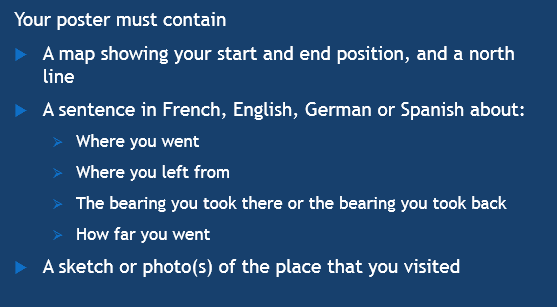
Here's the overview of the students' brief, which I cut down into individual tasks with time limits, so that the poster was fully planned before they were "let loose" on the coloured card and pens!


And the phrases that were kindly provided...

After many questions and a lot of questions in the classroom, here are the finished products!


Sunday, 22 March 2015

#10minwin - Double-Sided Scaffolding

An idea which only popped into my brain whilst running through ideas with a music teacher... double-sided worksheets. Both sides have the same material covered, but one side has significantly more scaffolding.

This enables all pupils to be given the same sheet so no-one feels singled out, but pupils have a little more assistance if needed.

An example for an investigation of area and perimeter is below:
Non-scaffolded version - worksheets are given out this way up

Scaffolding for each section of the worksheet, specifically some examples to help pupils get started.

Monday, 20 May 2013

Think ... Notice ... Wonder

This post comes as a culmination of many blogs that I've read this week, on the wondrous app that is flipboard (I'm not plugging, I promise).

Epsilon-Delta wrote a fantastic post on Noticing and Wondering, taking any article, commenting on what they noticed and the further questions they wanted to ask about it.
Inspired by Dan Meyer's Maths Curriculum Makeover, I aim to get students to think about what it is they need to know, rather than simply plucking the available (and often only available) information out of the textbook question.

Caloric Quandry
With this in mind, and Geoff's post on Caloric Quandry, the following problem could be posed.
Which coke can is higher in calories?

I expect some of the following 'notices' to appear:

Notices
- one coke can is taller than the other
- one coke can is fatter than the other
- coke cans have a cylinder shape
.... etc.

Students would then move onto the questions they wanted to ask...


Constructions
 In an observed lesson on the construction of triangles, the following question was posed:

What do you need to know in order to produce an exact copy of this triangle?


I liked that the students then had to consider the angles and lengths of sides of the triangle rather than simply beginning with "this is how you construct an SAS triangle..."


Perhaps beginning with a less leading questions such as:
"Copy this triangle onto the paper in front of you"

Would encourage pupils to ask themselves the question "what do I need to know" rather than it being presented to them.

Once a large collection of different pieces of information had been gathered, the more focussed question of
"What is the smallest number of pieces of information you need to be sure you had it correct?"


Then later on...
"Are there 3 pieces of information that you could be given and still not be able to construct the triangle?"


Update 20/05/2013
Mr. Taylor used the Notice / Wonder technique fantastically with a Year 7 class last week - he puts its success down to the careful structuring and explanation of the technique, and reminding students when they didn't use "I notice" or "I wonder" at the start of their statements.

Sunday, 12 May 2013

An Insight from Canada

During the Easter Department week, we were graced by John Mason, who shared a wealth of ideas and thoughts with us on attention - here are just some of the few I managed to jot down.

Our first task of the morning was this:
We all initially considered it individually, then discussed our thought processes as a group. One person started looking at the overview first before focusing down, another looked for a particular corner first before the rest of the shape, and another was mesmorised by a certain part of the diagram!

When we were given the answer, it was noted that a variety of emotions: delighted / satisfied / depressed / cheated were felt, depending upon how far through the problem a person had worked.

Parking
One of the key ideas of the session was to develop pupils' ability to park an idea; when they had a good idea, temporarily put it to one side and see if there is a more efficient way of doing it, rather than just ploughing on through.

Just
Having said I'd aim not to use this word, I realise I've written it in the sentence above. "Just" implies a simple step, in the eyes of the speaker, but it may not be so in the eye of the listener, so should be avoided.
If a student is attending to a problem in a different way, they may not be able to hear what you're saying, unless you give sufficient detail to show how you are attending to it prior to any further development.

Group Discussion
Throughout this session, John elicited ideas from us and exemplified classroom techniques. The two I have taken away from this are:

Please
In PDP sessions in my S1 school, we were advised to use thank you rather than please as a behavioural technique. However, although this is effective in terms of showing pupils that a behavioural pattern is expected, I had almost forgotten where please could be used to equal effect/
As John called upon us to offer our opinion, he said please, inviting us to talk and demonstrating that he was interested in our comments.

I think I want to modify my conjecture
A helpful alternative to "bummer, that doesn't make any sense"

Say What You See (SWUC)
Possibly stolen from catchphrase this was really helpful in allowing pupils of all abilities to participate, such that everyone can succeed - it lowers the threshold. This was implemented with the image below.


Update 22/05/2013: Used this with a Year 9 class who weren't particularly vocal but came out with some good ideas, particularly when we allowed the large blue block to be worth £300 and determined how much each of the other blocks would be worth.
However, one comment: "I notice it's a fraction wall cos I did it in Year 8" was followed by further discussion, where the student in question knew it was a fraction wall but couldn't tell me any fraction that the wall could represent. Perhaps not so memorable, or not enough discussion in Year 8?

A Selection of Activities
Without time to comment on further, here are some of the other ideas that appeared in the session...


Thursday, 2 May 2013

Interactive Pythagoras

In an attempt to implement Dan Meyer's style of finding out which information is required to solve a problem, I inroduced strings, spiders and flies to my revision lesson on Pythagoras and Trigonometry.

Excuse the Perspective Please! Open-ended cuboid with string diagonally across, requiring 3D Pythagoras.

3 cuboids with one open end were constructed, with a piece of string running diagonally from the bottom left corner in the diagram to the nearmost top right hand corner. Students were then challenged to find the length of the string. At the end of the exercise, they were quite excited to rip the boxes open and check whether they were correct!

For the second activity, a spider was placed on one side of the room and a fly on the other side. They were asked to find the shortest distance that spider could travel to get to eat the fly.

A combination of 7 boys each holding metre rulers across the room as they were unconvinced that the room didn't have exactly parallel walls and ceiling/floor. Shortening of the route by going diagonally across the ceiling came quickly, but going diagonally across the whole route became a little more difficult. This practical is based upon the following worksheet question:


My hate of fizzy drinks meant that I didn't do this question today, but it might also be a good investigation for the future.


Monday, 4 March 2013

That's a Genius Idea!

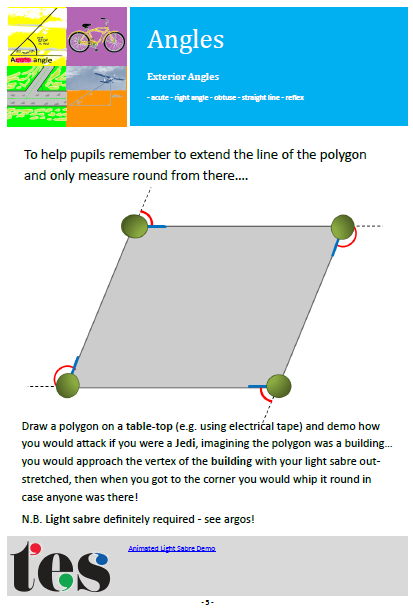
I've come to a stage where I've heard of and thought of lots of great ideas for teaching maths, but had no real way of sorting them, remembering them, or being able to search for them when re-teaching a topic.

So I've created a quick document which should give enough information to kick-start my memory and point me in the right direction to the resources on TES. The template is a work in progress... but essentially consists of:

  • main topic
  • sub-topic
  • key words (also helpful for when searching)
  • 4 real-life images relating to the topic (or something else if not yet thought of!)
  • main idea
  • links to TES resources


On the real-version (found here) all TES links are active. Hopefully a much better system than my brain!