Pages

Thursday, 8 June 2017

#10minwin AND & BECAUSE games

Hannah has been running a number of 15 minute INSET sessions before school and my first today was on Higher Order Questioning.

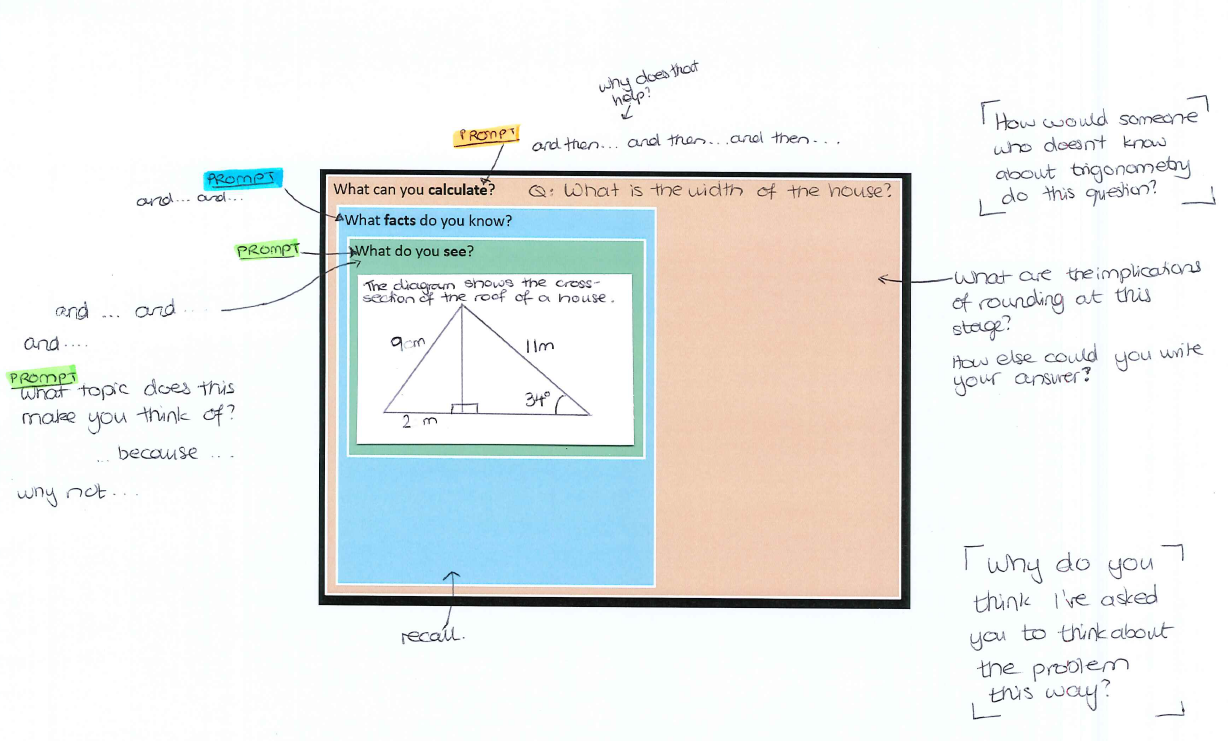
I particularly like the quick questioning technique of using and... and... and... as you pass between students to encourage them to come up with lots of ideas.
To encourage higher ordering thinking, you can change to because... because... because...

The beauty of this, it seems, is that you can switch between and / because / because.. because depending on which student you are asking to promote different levels of thinking on any given topic.

Here's how I might use it in a Pythagoras / Trigonometry question.


Stretching it even further are the extra questions in the boxes around the edge.

Thursday, 23 March 2017

Ratio with Bar Modelling

I currently run support classes for numeracy for years 4, 6, 8, 9 and 11.

Many of the students I see struggle to remember techniques, particularly when they are seemingly abstract.

Two main bits of inspiration brought me to re-teach ratio through bar modelling

(1) Concrete - Pictorial - Abstract
Research suggests students grasps concepts best if initially they can "play" with objects, then sketch it pictorially, before moving to the abstract technique.


(2) White Rose Maths Hub
With so many examples of bar modelling on their twitter feed @WRMathsHub, I visited their website and found a few bar modelling resources, here.

Ratio with Bar Modelling
Within the first 5 minutes the students appeared confident and comfortable with the new technique, and commented that it was much easier for them to understand what was going on.

Here is a little of their finished work:


These questions in their template can be found here.

Wednesday, 8 February 2017

Ski Slope Learning

After reading Miss B's blog on ski slope learning (https://www.missbsresources.com/maths-resources) I decided to give it a go with a @MathsMastery problem I'd seen this week:


Ski slope learning is essentially a student friendly differentiation technique to enable all students to make progress (from the top to the bottom of the ski slope), taking whichever route they think is best for them.


Here are the different "runs" for this problem:


Friday, 28 October 2016

What is the Question?

I'm trying to foster problem solving early with my year 7 class... here's what we've been trying for decimals.

Inspired by the Rio Olympic 100m swimming finals, they had about 6 standard questions to give some scaffolding first, such as "how much faster did Pieter swim 100m that Simone?"

Then we moved on to the outstanding questions below (questions are normally split up into good, excellent, outstanding/mastery).


Saturday, 3 September 2016

Cubic Tangents at Root Midpoints

In our geogebra inset session I was challenged to investigate cubic graphs. Specifically, for any cubic graph that has three distinct real roots....
(1) sketch the graph
(2) draw a tangent to the curve at all the midpoints of the roots
(3) what do you notice
(4) can you prove it?

Spoiler alert... Don't look below!

Proving it algebraically was a challenge initially, I'd recommend looking initially at the case where the midpoint of two of the roots is 0, then extend it. Have fun!


Friday, 1 July 2016

#10minwin Deepening Thinking Template

Following the OTP I've been looking for ways to really deepen thinking of all students, particularly with tasks that are self-differentiating.

I loved this idea from @MissDks2 ...

... so have been developing it for use with Year 7 Mastery SoL next year.

We're particularly looking at developing their questioning skills, hence the slight change to the template above

Here's the first draft, with an example of solving equations.

Template can be found here.

3 Act Lesson: Similar Shapes in Prison Break

I've long been a fan of Dan Meyer's 3 act lessons and this week have used the time to make the first of my own!

Since watching Prison Break a few years ago I remembered how much planning Michael (the lead male) has to put into getting his brother out of a high security prison... some of it has to be maths based right?

Riots, Drills and the Devil

In this episode Michael has to drill through a wall, using nothing but paper, pen (of course also his tattoo), a lightbulb and an eggbeater, to make holes at strength holding positions on the wall.
If he messes up, he'll drill through a pipe and be discovered.


Structure
I've added a little extra into the standard 3 act:
  • true or false: canvas opinion on the content of the lesson and challenge expectations
  • prequel: I expect only half the class will have seen Prison Break, so I've put in the opening credits to get everyone on the same level


Act 2 Information


The lesson closely relates to similar shapes, enlargement and trigonometry so could be used as an introduction or development in any one of these themes.

Enjoy!

Full powerpoint lesson here.
Link to resource on 101 Qs here.

Tuesday, 28 June 2016

See No Evil, Hear No Evil, Speak No Evil

This idea came from OCR
Get three volunteers from the class. They will sit at the front relatively far apart from each other. One of them will be blindfolded and will be ‘See no evil’, the other will have headphones on listening to music (at a reasonable volume but not enough to damage their hearing!) and be ‘Hear no evil’ and the other will not be allowed to speak and be ‘Speak no evil’. You each give them one piece of information from one square on Activity Sheet 4. You also inform ‘Speak no evil’ of what variable they need to find out. You give them a time limit of 5 minutes to communicate with each other all the pieces of information and they have to have a correct answer. This is a fun, end of topic activity that can be very entertaining to watch. The key is to use the whiteboards. The student who cannot see can speak and hear and similarly for the other students and their other senses. Students have to figure out a strategy to communicate their ideas to each other effectively. Remember they can write messages on their whiteboards which is crucial for the student who cannot hear or speak! You may want to do an example first. Students not involved should have access to the information you have given them and be encouraged to calculate the answer themselves. In fact you could make the rest of the class the judge of whether the particular group has succeeded in their task.

Thoughts
- students have to work as a team
- all students in team have to be involved for it to work
- what are other students in the class doing?
- does this have more impact than practising questions normally in groups?

Possible Adaptations
Although this might take a little while to explain the first time, it could be used again with other topics in small groups, where each of the roles (including teacher giving information) is taken by a set of 4 students, so all students are involved.

Monday, 27 June 2016

Mastery Assessment Idea

There was a lot of discussion on the UKMT course about the Mastery scheme of learning - I thought this idea was interesting for mastery assessment for year 7...


The Scheme of Learning is divided into 4 sections

  • introduction
  • shallow
  • deep
  • profound / mastery

And the assessment is given in exactly the same format, as shown above (sample of a double-page spread).

All students across the year sit the same test in the same time limit.

Students do whichever questions they think they can do, for example a mid set might aim to do all of columns 1 and 2, then go back and try some of column 3.
A top set might be expected to complete all columns on the paper.

I like that all students may attempt questions, for example a mid-set student if very confident with area could attempt column 4, but then perhaps might only be able to do column 1 on fractions.

Assessment scores could be a stumbling block here - you couldn't give a straight % as the lower sets would likely be very despondent with their results. We discussed the idea of normalising each set to the top mark, in the same way that some university exams are done.

Food for thought!

Wednesday, 22 June 2016

#10minwin: Flipped Learning Teamwork

I really loved the idea (seen here) of students getting lots of video input from different sources and then sharing it in the classroom, so I'm going to embed this into the Flipped Learning course I'm running for the M1 module of A Level Maths.

Students sit on tables of 4, so each person in the group will select a different video to watch in advance of the lesson.
The following lesson, they will then feed back to their peers and if all goes well have all the knowledge required!


Most students have really enjoyed being in control of their knowledge learning pace by using the flipped classroom this year, so this activity should hopefully tackle the "you can't force me to watch the video before the lesson" as this time they'll be letting down their group and friends if it's not done.

File template can be found here.


Tuesday, 21 June 2016

#10minwin Daily Nuggets

At the end of each session on the OTP course, we wrote a "nugget" of the idea that we were going to takeaway from the day. I loved this idea, because you get bombarded with so many good ideas on the best courses that it's hard to know what to try or implement first.


I figured students must be the same, so we've started the daily nugget, where each day one student is responsible for recording the "nugget" of information that is most important.

We're keeping this on a poster in the classroom, so they can be perused anytime, and will also make a revision starting point when we get closer to exams.

The template for this can be found here.

UPDATE: slightly different version for Year 12...

#10minwin: Speed Mathing

A lot of what we do at GCSE level is recapping knowledge that at least some students already have, so the idea behind this is
"the knowledge is in the room"
(thanks to James Wise & Simon Thompson for this!)

Each student was given some information about a unit conversion, from which they had to come up with a problem and write it on a post-it.

Students then arranged their chairs in two rows (they were surprisingly efficient at doing this!), and they had one minute to ask a question, including how to apply any conversion facts they were given.


These are a few of the question which have been collated and will form part of a procedural revision bank for later in the year.

We'll also be doing this tomorrow to recap angle rules, where each table will be given an angle fact as well as some examples and non-examples, then will speed math to share it.
The goal is a much higher engagement in the learning than recapping as a whole class.

Wednesday, 15 June 2016

Manglish: Comprehension in Worded Maths Questions

With the GCSE Numeracy a little over 4 months away, we're really focussing on honing Year 10's problem solving skills. Here's a lesson I did last week to work on just that.

Starter
As usual, on the board as they came in. My goal here - productive panic. Students had become a little overconfident in how prepared they are for the exam, so I needed them to feel what it would be like if the exam was tomorrow, in the panic zone.


We then reflected on feelings: too hard, panic, didn't know what a frustum was etc. This was the motivation for the lesson, they now knew why it was that we needed to revisit the IMCA model that we'd started the year with.

IMCA Model
Next they were given the template below, same question but guiding them through each aspect of IMCA. After a discussion with the English dept, some comprehension style questions were given for Information.


Methods were given to choose from, with the idea of there being some red herrings in, e.g. if the question was about circumference, area was also an option.
- PAUSE -
Students were only allowed to answer these first 2 sections, and this was done in silence. Only at this point were they allowed to collaborate to do the calculations, though most chose to carry on independently.

Here we really emphasised that before writing the answer, they should revisit the "what is the question" in the information section to make sure they were actually answering it!

Reflection
Pupils now felt more confident again, they were back in their comfort zone. I asked for feedback on the model, to which I had a fantastic response:
"I feel really confident answering these questions when there is guidance, but in an exam I could never think of this myself."
This led neatly on into the second phase... creating the scaffolding.

Phase 2
Students worked in pairs on an unseen problem (each pair had a different problem) to create scaffolding similar to what I had given them for the first phase. This enabled them to really think about what the important information was so they could ask questions about it. They were also great at being mean and choosing really similar topics for the methods section which weren't quite right!

Phase 3
Quick task, which involved swapping with another pair, and using their scaffolding for guidance.

Plenary
We agreed that they would become better at coming up with the questions if they had more practice, so that's exactly what we'll do! We also agreed that the end goal was for the template to become internal, so they were self questioning rather than peer questioning.


Resources can be found here.
Sunday, 28 February 2016

#10minwin - RAG

I've read a lot about teachers who get students to self-assess and RAG, but following an activity this week realised I haven't helped students understand how to assess themselves properly.

In an activity where students wrote a tough question on a post-it that they could answer, they then circulated the room and asked each other in pairs. If they both got it right, they switched post-its, if a mistake was made then the answer had to be explained.

During feedback following the activity, a student commented that some of the time if he made a mistake, the "asker" was able to give the answer but not explain it, so he didn't feel he'd learnt. So here comes the new self-assessment criteria (note the "yet"):


I intend to use this both as a whole class activity (using coloured ABCD cards) and also getting students to highlight in the margin next to a specific skill or question.

#10minwin - Question, Feeling, Learning Plenary

Following a session on our New Staff Induction meetings, I've been using the Question - Feeling - Learning activity as a plenary.

In summary, students are asked to stand by one of the 3 posters (around the room), according to what they'd like to share about the lesson:
- do they have a question to ask?
- how do they feel about the topic / lesson?
- what have they learnt today?


Students appear to have really enjoy this as it gives them a real chance to be heard. However, as one of the classes I do this with has 35 pupils, it's impossible to hear from them all at once! In a coaching session this week we discussed how to address this, with the following ideas that I'm eager to try this week. The aim is to hear from all students, albeit it sometimes indirectly by getting students to form subsets (yes, maths in pedagogy - thank you coach!) as well as giving learners a sentence starter to help them phrase their thoughts.

Feeling

Tasks
- join to a group of people who share your feeling
- find a person who feels the opposite way to you, and find out why

Sentence Starters
"I feel... because..."
"I feel .... but last lesson I felt..."


 Question: sentence starters
Tasks
- join to a group of people that have the same question as you
- ask your question to the "question" group and see if anyone can answer it

Sentence Starters
“I’d like to know why…”
“I understand … but I’m not so sure about ….”

 Learning
Tasks
- join with other people that have learnt the same thing as you
- explain what you have learnt to someone else in the "learning" group

Sentence Starters
“I didn’t know how to do … before, but now I can.”
“I’ve learnt that it’s a good idea to…”
“I’ve learnt that it’s OK to…”

Monday, 1 February 2016

GCSE Maths and Numeracy Problem Solving

Here in Cardiff we've been hit with the new numeracy GCSE, which contains a lot of worded problems - shifting the focus from procedural to reasoning questions.

I've been slowly collating a bank of questions to help students prepare for this question type, using the IMCA technique:


  • Information (highlighting data, what is being asked)
  • Method (what techniques are likely to be needed) 
  • Calculations (full working)
  • Answer (short sentence to answer the question)
Please find the resource thus far here - answers are being added slowly in the notes of each slide!

Friday, 6 November 2015

#10minwin : I Wish I Had (IWIH) / I Wish I Knew (IWIK)

At the end of a recent test, students were asked to write a sentence on a post-it that started:

  • IWIH (I Wish I Had)
  • IWIK (I Wish I Knew)
(they stuck it on the board underneath the heading they'd chosen)

These were then collated and formed the start of our test feedback lesson:

We started off with students volunteering to offer advice to any of their peers for the IWIK / IWIH statements that were projected on the board. 

Students enjoyed and were engaged in the tailored feedback as it was their concerns and thoughts that were immediately addressed. And it took just a few minutes to plan but was maximum impact!

Breaking down the new GCSE - Group Work

Following a recent test, my Year 10 class were baffled by the following problem, despite their confidence in the key skills behind it:

So we broke down the problem into individual cards.


Within each group, there were 4 roles (inspired by a recent CPD session):
  • Reader: only person whose voice can be heard
  • Judge: writes the letter on a post it and puts on scale
  • Justifier: writes reason on a post it for the judges position (no discussing!)
  • Methoder: writes maths method (e.g. standard form) on post it

The reader reads out each of the individual cards, while the judge decides how difficult the question is. During the activity it looked something like this:

So within the group they were able to see that none of the skills in the question were "too" tough for them (though they hadn't been told that it linked to the test question until they figured that out!)

Their feedback on the task:
  • felt more focused to  concentrate on listening to the reader really carefully
  • sometimes the justifier wanted to disagree with the judge!
  • reader had to make sure they were really clear as they weren't allowed to show the card to anyone else

After this, they were re-presented with the original question, and using the cue cards, they were then allowed to talk to each other to arrange the steps into an order in which they could have solved this 6 mark question.

Tuesday, 13 October 2015

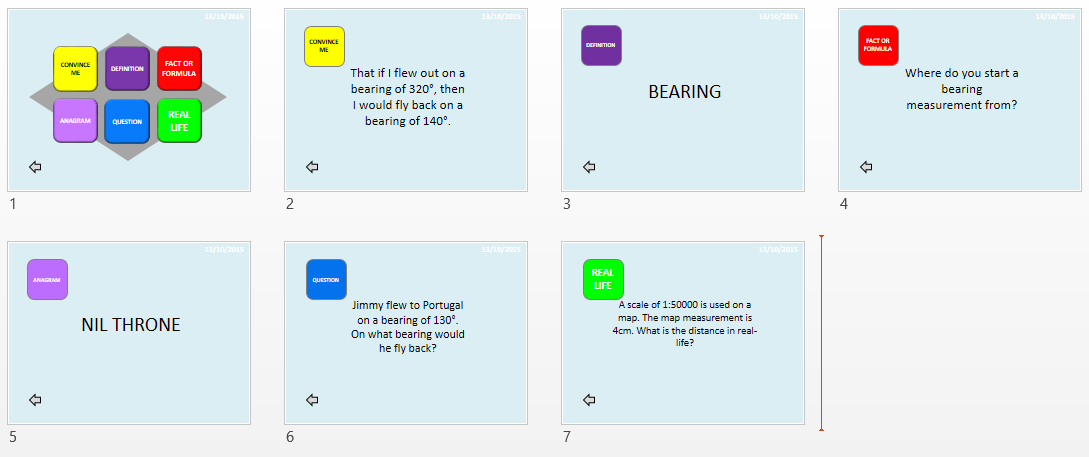
#10minwin - 6 Questions

A quick plenary with 6 styles of question:

  • convince me
  • fact or formula
  • definition
  • anagram
  • question (procedural)
  • real-life (problem solving)


1st page (above) is hyperlinked so students can select which type of question they'd like to do (or all of them!)

Tuesday, 30 June 2015

Circle Theorems Pile-Up

In trying to assess as many circle theorems at once, and inspired by the Trigonometry Pile-Up, I attempted to create a double-sided scaffolding worksheet for this.

Worksheet below!

Front Side: unscaffolded worksheet for students to attempt to find the labelled angles.

Reverse Side: hints given to guide pupils in finding the labelled angles.